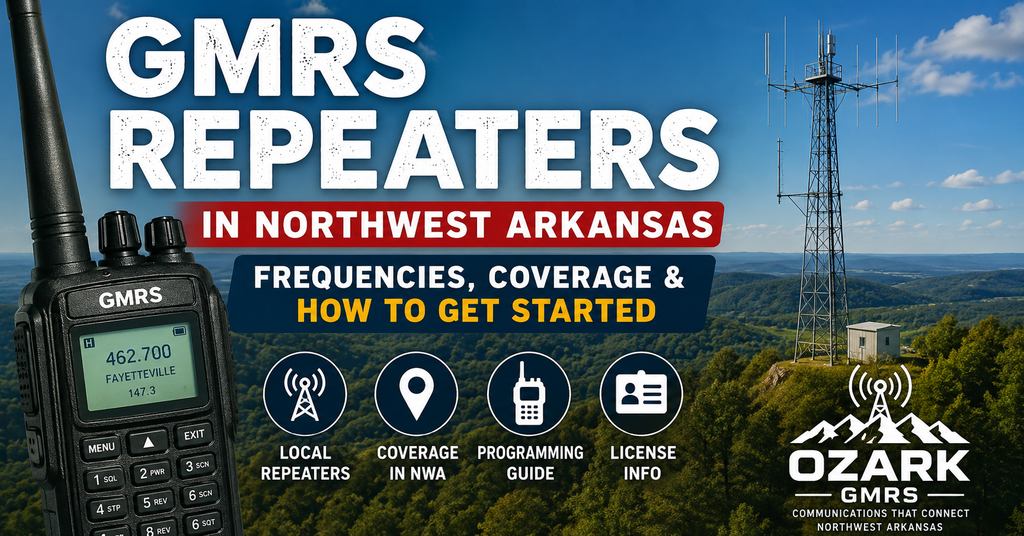
GMRS Repeaters in Northwest Arkansas: Frequencies, Coverage & How to Get Started
If you use a GMRS radio in Northwest Arkansas, repeaters can dramatically increase how far you can communicate compared with handheld-to-handheld simplex operation.
Northwest Arkansas has several GMRS repeaters serving communities including Fayetteville, Springdale, Rogers, Bentonville, Lincoln, Prairie Grove, Tontitown and surrounding areas of the Ozarks.
This guide explains how GMRS repeaters work, where to find local repeater information and how to get your radio programmed to use them.
What Is a GMRS Repeater?
A GMRS repeater receives your radio transmission on one frequency and retransmits it on another.
Because repeater antennas are often installed at much greater elevations than a handheld or vehicle antenna, they can provide communications across a considerably larger area.
For example, instead of two handheld radios attempting to communicate directly across Northwest Arkansas terrain, both radios may be able to reach an elevated repeater that relays their transmissions.
That doesn’t mean every repeater will work everywhere. Hills, valleys, buildings, antenna height and radio power can significantly affect coverage throughout the Ozarks.
Northwest Arkansas GMRS Repeaters
Ozark GMRS maintains information about repeaters serving Northwest Arkansas and surrounding communities.
Fayetteville 700
462.700 MHz
+5 MHz offset
141.3 Hz CTCSS
Fayetteville 700 serves Fayetteville, Springdale and surrounding portions of Washington County, with usable coverage extending farther under favorable conditions.
Ozark GMRS has conducted real-world coverage testing of this repeater throughout Northwest Arkansas.
Fayetteville 700 is also home to the local Tuesday Night GMRS Net at 8:00 PM.
Bentonville 625
462.625 MHz
+5 MHz offset
107.2 Hz CTCSS
Bentonville 625 provides an important GMRS resource for operators around Bentonville, Rogers, Bella Vista, Centerton and northern Benton County.
Terrain and development can affect coverage, so Ozark GMRS is continuing to collect real-world reports from users throughout Benton County.
Lincoln 725
462.725 MHz
+5 MHz offset
141.3 Hz CTCSS
Lincoln 725 provides coverage around Lincoln, Prairie Grove and western Washington County, with reception potentially extending into surrounding areas depending on terrain and equipment.
Tontitown 650
462.650 MHz
+5 MHz offset
162.2 Hz CTCSS
Tontitown 650 serves another important portion of Northwest Arkansas and gives GMRS operators an additional repeater option in the region.
Additional repeaters serving the Ozarks are available in the Ozark GMRS Repeater Directory.
Which Repeater Should I Use?
The best repeater isn’t necessarily the one geographically closest to you.
Northwest Arkansas terrain makes radio coverage highly dependent on elevation and what lies between your antenna and the repeater.
A station several miles farther away with a favorable path may provide a stronger signal than a closer repeater hidden behind a ridge.
Program several local repeaters into your radio and listen to them from the places where you normally travel.
That could include your home, workplace, commute, favorite recreation areas and locations where you might want communications during a power or cellular outage.
How Do I Program a GMRS Repeater?
Most GMRS repeaters use two frequencies separated by 5 MHz.
For example, Fayetteville 700 uses:
Receive: 462.700 MHz
Transmit: 467.700 MHz
Offset: +5 MHz
CTCSS: 141.3 Hz
Many dedicated GMRS radios already contain standard repeater channels. In that case, programming may be as simple as selecting the appropriate repeater channel and setting the required CTCSS or DCS tone.
Other radios can be programmed using manufacturer software or compatible programming applications.
The Ozark GMRS Programming Center provides programming information and downloadable resources for popular radios used around the Ozarks.
Do I Need a License?
Yes. The FCC requires a GMRS license to transmit on GMRS frequencies in the United States.
There is no examination required for a GMRS license.
An individual GMRS license also extends operating authority to certain immediate family members under FCC rules.
If you haven’t obtained a license yet, visit the Ozark GMRS Getting Started section for step-by-step information.
You can listen to GMRS communications without transmitting while you’re learning how the system works.
What Radio Do I Need?
You need a repeater-capable GMRS radio to take advantage of local repeaters.
Handheld radios are convenient and can perform surprisingly well when they have a clear path to a repeater.
Mobile radios installed in vehicles generally provide considerably more transmit power and can use larger external antennas.
Base stations can benefit from outdoor antennas mounted higher above the surrounding terrain.
But more power doesn’t automatically mean more range.
In the hills of Northwest Arkansas, antenna location and elevation can be just as important as transmitter power.
Try a Radio Check
Once your radio is programmed correctly, listen first.
If the repeater isn’t being used, you can make a simple radio check:
“This is [your GMRS callsign] requesting a radio check.”
Then wait.
If another operator is monitoring, they may respond with information about how well your signal is reaching the repeater.
Don’t be discouraged if nobody answers. A repeater can be working perfectly even when nobody happens to be listening.
Help Map GMRS Coverage Across the Ozarks
Repeater directories can tell you where a repeater is located and how to program it.
They don’t always tell you what happens when someone actually tries using it from a particular road, neighborhood or valley.
That’s something Ozark GMRS is working to document.
We’re collecting real-world observations from GMRS operators throughout the region, including successful contacts, weak-signal areas and locations where terrain prevents repeater access.
These reports help build a more realistic picture of GMRS communications throughout the Ozarks.
Explore Ozark GMRS
If you’re new to GMRS, start with Getting Started.
If you already have a radio, visit the Programming Center.
To find a system near you, explore the GMRS Repeater Directory.
And if you’re in Northwest Arkansas, listen for local operators and introduce yourself.
GMRS becomes considerably more useful when you know both how your radio works and who is listening on the other end.